The Battle Is Not Yours In this message from 2 Chronicles 20, Dr. John Carmichael reminds us that when life surrounds us and our strength runs out, God steps in. Through prayer, humility, and praise, we learn how to shift our eyes from the battle to the Lord—and watch Him fight on our behalf. If you’re facing pressure, fear, or uncertainty, this message will anchor your faith and restore your confidence that God is with you and working for you.
Church, we are not doing something new. We are doing something ancient and biblical.
We are concluding 21 days of fasting, a season of humbling the flesh, sharpening spiritual sensitivity, and seeking the presence of God. Now, as Scripture often shows, fasting is followed by consecration, and consecration is followed by release into purpose.
In Exodus 30, God gives Moses instructions for a holy anointing oil; not for display, not for emotion, not for imitation, but for setting apart people and places for His presence.
We are not treating oil as magic. We are treating oil as obedient faith, just as the New Testament instructs.
Why does this matter today? Because the church doesn’t need more activity. It needs holy presence. Exodus 30 teaches us that God’s anointing is not man-made, not flesh-driven, and not for imitation. The Holy Spirit is given to consecrate lives, not promote personalities. In the New Testament, the Spirit doesn’t lower the standard. He raises it. Presence comes before power. Consecration comes before commission. We don’t control the Holy Spirit. We make room for Him.
What does this passage teach today’s NT about the anointing? Here are five lessons from this passage about the anointing.
The Anointing Originates With God, Not Man
[Exo 30:22-23 NASB95]
The anointing begins with divine initiative
God defines: The ingredients, The proportions, The purpose
The Spirit is not accessed through technique, but through obedience and surrender.
This guards us from: Emotional manipulation, Manufactured spirituality, Flesh-driven ministry
The anointing always flows from heaven downward, never from the ground upward.
The Anointing Is for Consecration Before Empowerment
[Exo 30:26-29 NASB95]
Everything anointed becomes holy: The tabernacle, The altar, The vessels, The priests
“You shall consecrate them, that they may be most holy.”
God anoints what He intends to inhabit.
Pentecostal theology affirms: Power flows best through a set-apart vessel, Usefulness follows holiness, not the other way around
This aligns with the insight noted by David Guzik, “the Spirit is not poured out to glorify flesh, but to glorify God.”
The Anointing Is Never Meant to Enhance the Flesh
[Exo 30:32 NASB95]
This is not about skin. It’s about fallen human nature.
Pentecostal warning: The Spirit does not empower ego; The Spirit does not decorate ambition; The Spirit does not serve self-promotion
The anointing comes after the fast, not to reward discipline, but to mark surrender.
The Anointing Cannot Be Imitated or Manufactured
[Exo 30:32-33 NASB95]
This is a serious prohibition. The work of the Holy Spirit: Cannot be copied; Cannot be produced; Cannot be replaced with emotional substitutes
As G. Campbell Morgan warned, sacred things must never be used for personal gratification.
Pentecostal conviction: we want real oil, not strange fire.
The Anointing Releases Holy Influence
[Exo 30:29 NASB95]
This is not superstition, it is presence theology.
Biblical pattern: God anoints → His presence rests → holiness spreads
This anticipates the New Testament practice [Jas 5:14-15 NASB95]
Oil is: A point of obedience, A release of faith, A sign of yielded trust in God’s work
PRACTICAL APPLICATION (today)
We are praying over oil as an act of consecration
You will take it home to: Anoint your home; Anoint yourself; Anoint your family
Not for superstition; not for control; but as a declaration: “This belongs to the Lord.”
The anointing of the Holy Spirit is not given to enhance our flesh, but to consecrate our lives so God’s presence can rest, remain, and work through us.
Filled to Know: Walking in Clear Direction from God
[Col 1:9 NASB95]
Many believers sincerely ask, “God, what do You want me to do?” Yet remain stuck, confused, or paralyzed by uncertainty. Scripture does not portray God as distant or silent toward His people. Paul’s prayer in Colossians 1:9 reveals that clarity is not accidental; it is cultivated through prayer, surrender, and spiritual maturity.
This is not merely about decisions. It is about alignment. Direction flows from depth. When the Holy Spirit fills us, He does not just inform us; He transforms the way we discern, choose, and walk.
What does Colossians 1:9 teach today’s believer about knowing God’s Will?
Here are four principles that can inform us to about knowing God’s Will.
Clear Direction Begins with Being Filled, Not Merely Informed
“…that you may be filled with the knowledge of His will…”
“Filled” (Greek: plēroō) implies completeness, saturation, not partial insight.
God’s will is not grasped intellectually alone. It is received relationally.
[Rom 12:2 NASB95]
Trust precedes direction. [Pro 3:5-6 NASB95]
The Spirit guides into all truth. [Jhn 16:13 NASB95]
Stop asking God only for answers; ask Him for fullness.
Reduce noise (overthinking, fear, competing voices) so the Spirit can saturate your heart.
Make prayer a place of filling, not just decision-making.
God’s Direction Operates Through Spiritual Wisdom, Not Natural Reasoning
“…in all spiritual wisdom…”
This wisdom is pneumatikos; Spirit-originated, not human deduction.
God often reveals direction that contradicts natural logic but aligns with divine purpose.
Spiritual things are discerned spiritually. [1Co 2:9-14 NASB95]
God gives wisdom generously when asked. [Jas 1:5 NASB95]
God’s ways transcend human reasoning. [Isa 55:8-9 NASB95]
Do not dismiss a leading simply because it feels risky or unconventional.
Learn the difference between anxiety-driven thoughts and Spirit-initiated promptings.
Cultivate sensitivity through fasting, worship, and time in the Word.
Understanding Comes So We Can Walk, Not Merely Know
“…and understanding.”
“Understanding” (sunesis) implies the ability to put pieces together. To know how to act.
God gives direction with movement in mind.
[Psa 32:8 NASB95]
Understand the will of the Lord to walk wisely. [Eph 5:15-17 NASB95]
The Spirit redirected Paul through discernment, not a roadmap. [Act 16:6-10 NASB95]
Obedience often reveals the next step, not the entire plan.
Write down what God shows you. Clarity increases with obedience.
Refuse paralysis; step out in faith with what you already know.
Clear Direction Produces a Life That Pleases the Lord
(Colossians 1:10 – the result of verse 9) [Col 1:10 NASB95]
Direction is validated by fruit, not just feelings.
God’s will always leads to a life that reflects His character.
The fruit of the Spirit confirms the path. [Gal 5:22-25 NASB95]
God’s Word guides step by step. [Psa 119:105 NASB95]
Direction is tested by fruit. [Mat 7:16 NASB95]
Ask: Does this direction increase Christlikeness?
Seek confirmation through Scripture, godly counsel, and inner witness.
Expect peace; not necessarily comfort; as a marker of God’s leading.
God does not hide His will from hungry hearts. He fills surrendered lives with Spirit-given clarity so they can walk confidently in His purposes.
God’s will is not locked behind mystery. It is revealed to those who pursue fullness. Colossians 1:9 reminds us that clarity flows from communion. When the Holy Spirit fills us, confusion gives way to confidence, fear yields to faith, and wandering turns into purposeful walking.
You do not need to beg God to speak. You need to position yourself to hear.
We live in a culture that believes only in what it can see, measure, and control. Unfortunately, much of the modern church has adopted the same worldview. A Christianity that believes in heaven but lives as if earth is all that matters.
The Bible never tries to prove the spirit realm; it presumes it. The things which are seen are temporal, but the things which are not seen are eternal.
What are some principles that pertain to being awakened to the unseen?
Here are five principles that pertain to being awakened to the unseen.
THE UNSEEN REALM IS REAL, ACTIVE, AND GOVERNING
[2Ki 6:15-17 NASB95]
Elisha does not pray for new angels. He prays for opened eyes. The armies of heaven were already there.
[Heb 11:3 NASB95] [2Co 4:18 NASB95]
Faith is not denial of reality. It is alignment with the deeper reality.
This is not mysticism or escapism. We do not deny the natural; we interpret it correctly.
WHEN THE SPIRIT REALM IS IGNORED, CHRISTIAN PRACTICES LOSE POWER
[Eph 6:12 NASB95]
Paul does not say some battles are spiritual. He says our struggle is not against flesh and blood.
Prayer Becomes Performative Instead of Combative.
Without spiritual awareness: Prayer becomes comfort language; Prayer becomes religious self-talk; Prayer becomes crisis management
With spiritual awareness: Prayer is engagement; Prayer is resistance; Prayer is alignment; Prayer is enforcement of heaven’s will
Prayer is not asking God to do something He already decided—it is agreeing with what heaven is doing and releasing it on earth.
[2Co 10:4-5 NASB95]
Not every problem is a demon, but every believer lives in a spiritual conflict. Ignoring that conflict does not make us mature. It makes us vulnerable.
SCRIPTURE IS NOT JUST TRUTH TO BELIEVE, BUT AUTHORITY TO ENFORCE
[Mat 4:1-11 NASB95]
Jesus does not argue with the devil. He declares Scripture. The Word is treated as a legal instrument in the spiritual realm.
The Word creates. The Word confronts. The Word executes judgment. The Word establishes boundaries.
With the spirit realm: Scripture reveals authority; Scripture exposes enemy schemes; Scripture teaches spiritual law; Scripture trains discernment
The Word is not just truth; it is a weapon, a plumb line, and a legal document in the courts of heaven.
[Heb 4:12 NASB95] [Psa 149:6-9 NASB95]
We do not shout Scripture to impress people. We speak it because the spirit realm recognizes authority.
Speak one Scripture you know aloud, not loudly, but intentionally; as an act of spiritual alignment.
THE CHURCH IS AN EKKLESIA, NOT A WEEKLY EVENT
[Mat 16:18-19 NASB95]
Ekklesia is not a religious gathering; it is a governing assembly.
The church: Legislates heaven’s will; confronts darkness corporately; shifts atmospheres through unity
[Eph 3:10 NASB95] [Act 12:5-11 NASB95]
In Scripture, the church is not: A service you attend; A sermon you consume; A building you support
When the spirit realm is ignored, church becomes: Redundant, Replaceable, Consumer-driven
When the spirit realm is recognized, church becomes: A place of corporate authority; A place where atmospheres shift; A place where heaven is enforced on earth
Church is not a substitute for personal faith, but personal faith is incomplete without corporate authority.
“I am not just attending church. I am part of God’s governing assembly.”
TO BE “IN THE SPIRIT” IS TO SEE, HEAR, AND RESPOND FROM HEAVEN’S PERSPECTIVE
[Rev 1:10 NASB95]
“To be in the Spirit” is not emotional loss of control. It is spiritual location and perception.
Biblical markers of being “in the Spirit”: Heightened discernment; clear revelation; holy fear; willing obedience
[Eze 1:1 NASB95] [Act 10:9-16 NASB95]
We do not chase experiences. We pursue sensitivity. Encounters follow hunger.
“Holy Spirit, recalibrate my awareness to heaven’s frequency.”
God is not indifferent. He is actively, passionately committed to His purposes in this generation.
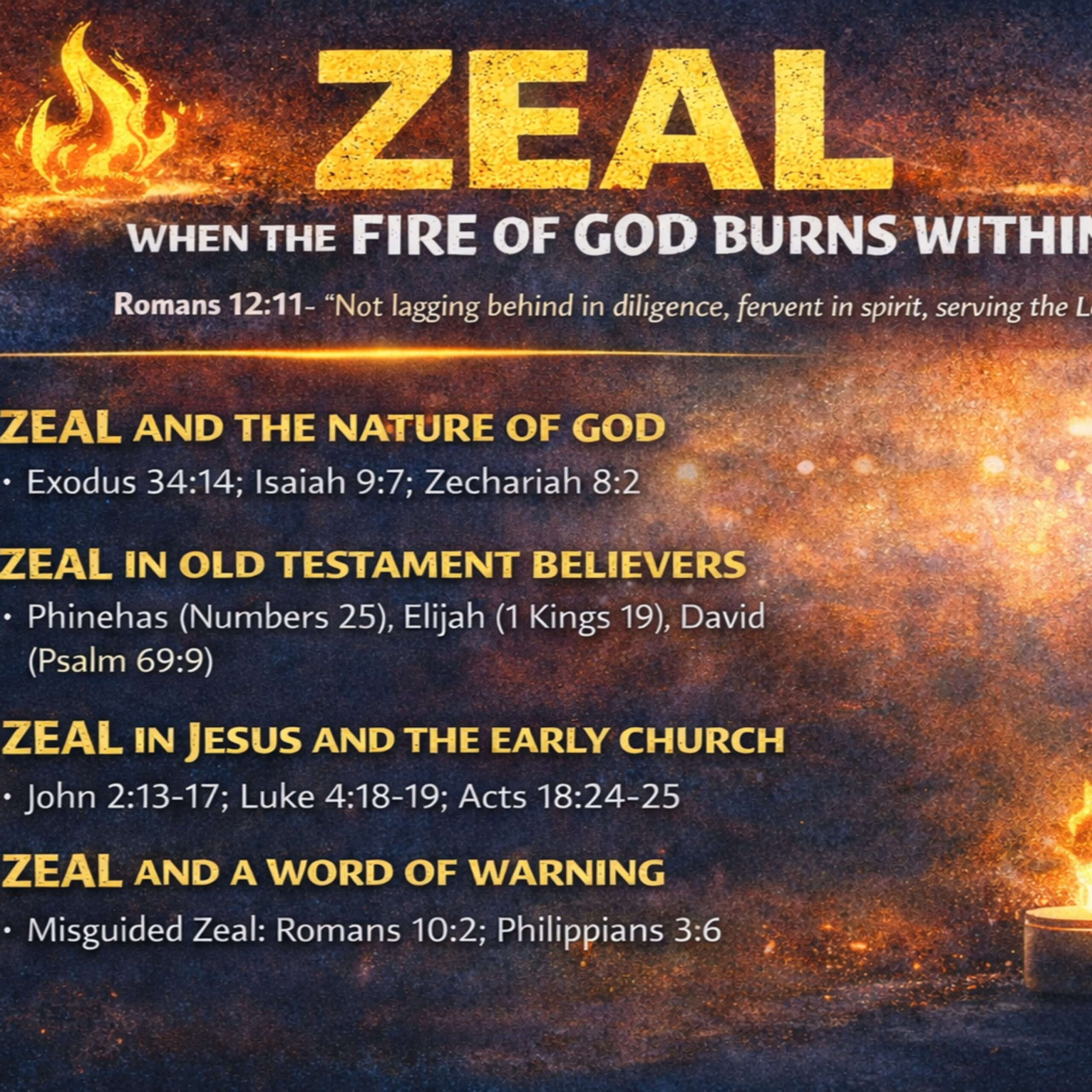
If God is zealous, then lukewarm Christianity is a contradiction.
Zeal is not something we “work up.” It is something we receive as we participate in God’s own burning concern for His purposes. Invite hunger, not hype.
Application: Revival starts when people realize God burns with desire for His people.
Ask: What has cooled my expectancy?
Zeal Has Always Marked God’s Revival People
Phinehas – Zeal for Holiness
[Num 25:6-13 NASB95]
God says Phinehas was “zealous with My zeal” (NKJV)
This is not violent enthusiasm, but alignment with God’s holiness when the covenant was threatened.
Zeal protects spiritual purity and covenantal boundaries.
Elijah – Fire Must Fall Again – 1 Kings 18; 1 Kings 19
Elijah saw fire fall, but still needed renewal. Revival fire must be maintained, not just experienced.
Yesterday’s fire cannot sustain today’s obedience
Burnout is not solved by rest alone. It is solved by God’s presence
“Where has the fire dimmed?” “Where have you kept going without burning?”
David – Zeal for God’s Presence
[Psa 69:9 NASB95]
David’s zeal was not for success. It was for God’s house.
Revival restores passion for God’s presence not personalities and programs.
The fire returns to the altar before it goes to the streets
Jesus: The Face of Holy Zeal (Shift: Christological Center)
[Jhn 2:17 NASB95]
Jesus was consumed, not irritated, by zeal for God’s dwelling place.
Revival confronts what crowds tolerate.
Jesus still cleanses temples, starting with hearts.
Application: Invite the Holy Spirit to search, cleanse, and reorder.
Do not rush: this is conviction without condemnation.
[Jhn 14:27 NASB95] 27 “Peace I leave with you; My peace I give to you; not as the world gives do I give to you. Do not let your heart be troubled, nor let it be fearful.
•
Why does this message matter? Because living without peace is killing us – literally. It’s destroying marriages, raising anxiety-ridden children, filling hospitals, emptying joy, and stealing destinies. The enemy knows if he can steal your peace, he’s stolen your power. Today, we’re taking back what the enemy has stolen!
•
We live in a world that’s desperate for peace. People are medicating for peace, meditating for peace, manipulating their circumstances for peace. They’re chasing peace in relationships, bank accounts, job security, and controlled environments. But the peace the world offers is fragile – it evaporates the moment circumstances shift.
•
But there’s another kind of peace available to the believer. It’s not manufactured by our efforts or dependent on our situations. It’s supernatural. It’s a peace that doesn’t make sense to the natural mind. It’s the peace that Jesus spoke of in the upper room on the night He would be betrayed. It’s the peace that kept David sleeping soundly while enemies surrounded him. It’s a peace that acts as an umpire in our hearts, making decisions when we’re confused. It’s perfect peace that guards those who trust in God.
What does the Bible say about supernatural peace and how to walk in it?
Here are four dimensions of this supernatural peace and how you can walk in it consistently.